
The Altar of Burnt Offering: Total Surrender
The Sacrifices: Pointing to Christ • ~6 min read
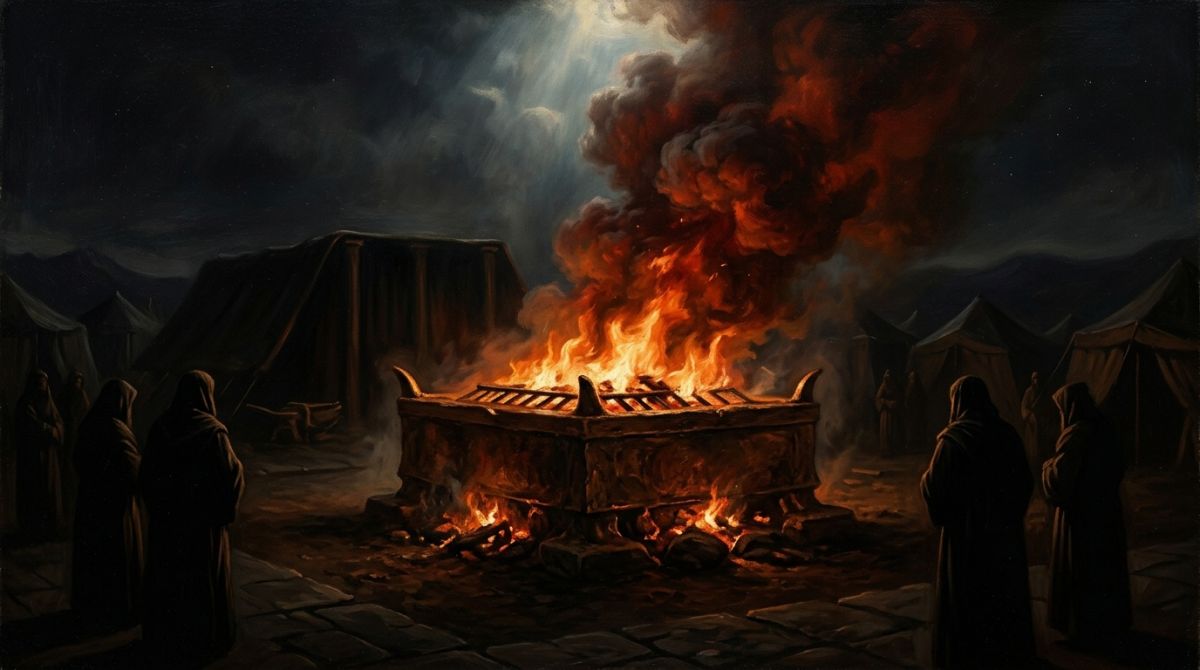
Welcome back to our study on God's Dwelling Place! As we journey through the sanctuary, we're discovering that every detail, every piece of furniture, and every service points us to the magnificent plan of salvation and the person of Jesus Christ. Last time, we began our exploration of the courtyard, where the first significant object to encounter was the Altar of Burnt Offering. This altar was not just a place of sacrifice; it was a profound symbol of total dedication and a powerful foreshadowing of Christ's complete surrender for us. Today, we'll delve into what this altar teaches us about unreserved commitment.
The Altar of Burnt Offering: A Picture of Total Dedication
Imagine standing in the courtyard of the ancient tabernacle. The first thing you would see upon entering was the large Altar of Burnt Offering, made of acacia wood overlaid with bronze. It was here that the daily and special sacrifices were made, and its very design and function spoke volumes about God's expectations and His provision for humanity.
The most striking feature of the burnt offering was its completeness. Unlike some other offerings where only a portion was burned, the burnt offering was entirely consumed by fire. Let's look at the instructions given in Leviticus:
And he shall flay the burnt offering, and cut it into his pieces.
Leviticus 1:6-9
And the sons of Aaron the priest shall put fire upon the altar, and lay the wood in order upon the fire:
And the priests, Aaron’s sons, shall lay the parts, the head, and the fat, in order upon the wood that is on the fire which is upon the altar:
But his inwards and his legs shall he wash in water: and the priest shall burn all on the altar, to be a burnt sacrifice, an offering made by fire, of a sweet savour unto the LORD.
Did you notice that word "all"? Every part of the sacrifice – the head, the fat, the inwards, the legs – was to be consumed by fire. Nothing was held back. This signified a complete, unreserved dedication to God. When an Israelite brought a burnt offering, it was an act of worship symbolizing their entire consecration to the Lord, acknowledging His absolute ownership and their desire to give Him everything.
It was also a voluntary act, made by the offerer for atonement:
If his offering be a burnt sacrifice of the herd, let him offer a male without blemish: he shall offer it of his own voluntary will at the door of the tabernacle of the congregation before the LORD.
Leviticus 1:3-4
And he shall put his hand upon the head of the burnt offering; and it shall be accepted for him to make atonement for him.
This voluntary surrender, leading to atonement, beautifully points us forward to the ultimate sacrifice.
Christ's Complete, Unreserved Surrender
The Altar of Burnt Offering, with its demand for total consumption, found its perfect fulfillment in Jesus Christ. He is the Lamb of God, the ultimate burnt offering, who gave Himself completely, holding nothing back, for our salvation. His life was one of perfect obedience and unreserved surrender to His Father's will.
Therefore doth my Father love me, because I lay down my life, that I might take it again.
John 10:17-18
No man taketh it from me, but I lay it down of myself. I have power to lay it down, and I have power to take it again. This commandment have I received of my Father.
Christ's sacrifice was not forced; it was a conscious, voluntary act of love and obedience. He surrendered His divine prerogatives, took on human flesh, and lived a life completely dedicated to God's purpose. His surrender culminated on the cross, where He gave "all" for us.
And being found in fashion as a man, he humbled himself, and became obedient unto death, even the death of the cross.
Philippians 2:8
The prophet David, speaking prophetically of Christ, captured this spirit of complete dedication:
Wherefore when he cometh into the world, he saith, Sacrifice and offering thou wouldest not, but a body hast thou prepared me:
Hebrews 10:5-7
In burnt offerings and sacrifices for sin thou hast had no pleasure.
Then said I, Lo, I come (in the volume of the book it is written of me,) to do thy will, O God.
Jesus came to do God's will, completely and without reservation. His life and death were the ultimate "burnt offering," a perfect, sweet-smelling savour to God, securing our atonement.
Our Response: A Living Sacrifice
What does this mean for us today? The symbolism of the burnt offering and the reality of Christ's complete surrender call us to a similar response. If Christ gave His all for us, how should we respond?
The apostle Paul beautifully articulates our calling:
I beseech you therefore, brethren, by the mercies of God, that ye present your bodies a living sacrifice, holy, acceptable unto God, which is your reasonable service.
Romans 12:1
Just as the ancient burnt offering was entirely consumed, we are called to give our entire selves to God. But unlike the animal sacrifice, which was dead, we are to be a "living sacrifice." This means a continuous, daily surrender of our will, our desires, our time, our talents, our resources—every part of our being—to God's service. It's a daily choice to put God first, to deny self, and to follow Christ.
Then said Jesus unto his disciples, If any man will come after me, let him deny himself, and take up his cross, and follow me.
Matthew 16:24
This surrender isn't about losing ourselves, but finding our true purpose and joy in Christ. When we surrender our lives to Him, He lives His life through us:
I am crucified with Christ: nevertheless I live; yet not I, but Christ liveth in me: and the life which I now live in the flesh I live by the faith of the Son of God, who loved me, and gave himself for me.
Galatians 2:20
When we offer ourselves as living sacrifices, empowered by the Spirit and motivated by Christ's love, our surrender becomes a "sweet savour" to God, just as the burnt offering was. It is a pleasing and acceptable act of worship.
And walk in love, as Christ also hath loved us, and hath given himself for us an offering and a sacrifice to God for a sweetsmelling savour.
Ephesians 5:2
Conclusion
The Altar of Burnt Offering stands as a powerful symbol of total surrender. It vividly portrays Christ's complete, unreserved dedication to God's will, culminating in His atoning sacrifice on the cross. For us, it serves as a daily reminder of our call to be "living sacrifices" – to give our whole selves, without holding anything back, to the One who gave His all for us. May our lives reflect this beautiful truth of total surrender, becoming a sweet savour to our Lord.
Reflection Questions
- What does the complete burning of the sacrifice on the Altar of Burnt Offering mean to you personally regarding dedication to God?
- How did Jesus' life and death exemplify "total surrender" as foreshadowed by the burnt offering? What specific aspects of His life demonstrate this?
- Paul urges us to present our bodies as a "living sacrifice" (Romans 12:1). In what practical ways can you live out this principle in your daily life?
- What areas of your life might you still be holding back from God? How can you move towards a more complete surrender?